security
A lower AI bill your security team can sign off
The proxy that cuts your AI cost sits in the middle of your AI traffic, so security will ask the right questions: who can reach which model, what is kept, and how fast access can be cut off. Every person and every agent gets a named key, provider keys stay server-side, only metadata is logged by default, and you choose where it runs.
Works with any harness your team already uses


















how proxen helps
Every request named, capped and logged
Security teams inherit AI access the way it grew: API keys in repos, agents nobody registered, and no way to tell who did what. The proxy changes that as a side effect of cutting cost. Every request goes through one address, under a named key, inside a budget, with a log you can hand to an auditor.

Provider keys stay server-side
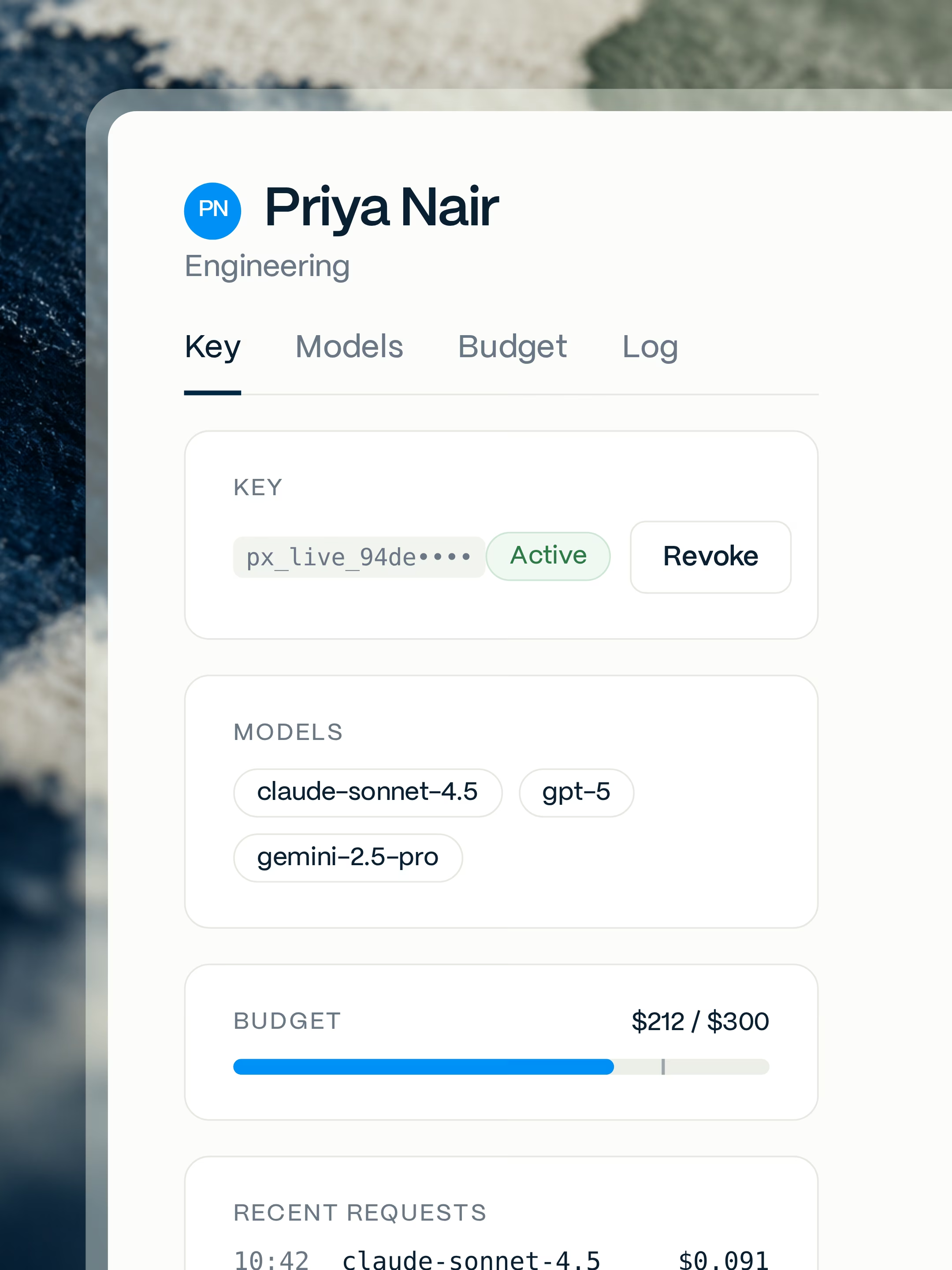
Your company's own Anthropic, OpenAI and Google keys are added once and stored on the Proxen server, encrypted, and never shown to a team member again. Nobody pastes a provider key into a laptop, a repo, a CI file or an agent config. People and agents hold Proxen keys instead, each scoped to a model list, a budget and a hard cap.
Why it matters: a leaked provider key is an open bill. The Register reported $82,314 charged to one leaked Gemini API key in 48 hours. A leaked Proxen key stops at its cap and is revoked in one click.
Per-person and per-agent revocation
Every person and every agent has its own key, so leaving the company, or shutting down a runaway agent, means revoking one key, not rotating a password that ten people know. Revocation takes effect on the next request. Keys can also be suspended for a contractor between engagements, scoped down for a role change, or set to expire on a date you choose. Onboarding is the reverse: issue a key, assign a team, done.
Why it matters: with a shared login a leaver still knows the password on their last day and every day after. With a key per person, access ends when you say it ends, and the log shows exactly when that happened.
Metadata-only logging, retention you choose
By default Proxen records who sent a request, which model answered, how many tokens it used and what it cost. Prompt and response bodies are not stored unless you switch that on. Retention is a setting: keep metadata for 30 days, a year or whatever your AI usage policy says, and purge on schedule. The log can be filtered by person, team, agent or model for any review.
Why it matters: you get the audit trail without creating a second copy of every contract and customer record your team has ever pasted into a chat. And it runs in our cloud or yours, so the gateway and its logs can run inside your own environment.
Key per person and per agent, revocable on its own without touching anyone else
Provider keys on anyone's laptop, in a repo or in an agent config
Charged to one leaked Gemini API key in 48 hours (The Register, Mar 2026)

What we promise your security team
The proxy sits in the middle of your AI traffic, so it is built to be private, capped and easy to leave.

Your accounts stay yours
Your Anthropic, OpenAI and Google accounts belong to your company, not to us. The keys sit server-side and nobody on the team ever sees them. Leave whenever you like and nothing breaks.

Prompts are not logged by default
Proxen records who sent a request, to which model, how many tokens and what it cost. Prompt and response bodies are not stored unless you choose to switch it on.

Budgets and hard caps
Every person and every agent gets its own key, with a monthly budget, an alert at 80 percent and a hard stop at 100. The savings come with a ceiling, so no month can surprise you.

Our cloud or yours
The proxy runs in our cloud or in your own cloud account. Every request runs on your company's own API accounts, inside the providers' terms. Send us your security questionnaire and we answer it in writing before you sign.
People
Set up with your security team
The proxy is built with you, not handed over as a default. We walk through your AI usage policy, data classification and retention rules, then set model lists, budgets, logging and hosting to match. Send us your security questionnaire and we answer it in writing before you sign anything. You keep ownership of every provider account throughout. These are roles, not named people.

Reviews how keys are stored, what is logged and for how long, and confirms every request runs on accounts licensed for team use. Walks your security lead through it.

Reviews your spend by model and task, then writes the rules that trim context, send easy work to cheaper models, cache repeated context and queue jobs that can wait for batch pricing.

If your company does not yet have API accounts with each provider, walks you through opening them in your name, so every token is licensed to you and you can leave at any time.

Sets up where the proxy runs, in our cloud or inside your own, and keeps it patched and monitored. Works with your infrastructure lead when you want it on your side of the line.

Prepares the monthly view of spend and savings by person, team, tool and model, and flags the patterns that point at the next saving.

Follows the usage policies of each provider and makes sure the accounts behind your keys are licensed for team use, so nothing you run depends on a grey area.
why it matters
An AI usage policy needs a layer that enforces it. The proxy is that layer.
A written policy says which teams may use which models, what may leave the company and who owns the spend. Without a layer in front of the providers, none of that is enforced. The proxy turns the policy into settings: model lists, budgets and logging per key, on API accounts your company owns.
Anthropic on gateways: the supported route for organizations
Anthropic's Claude Code documentation describes routing a team through an organization's LLM gateway: "the provider key stays server-side; developers hold gateway credentials instead." That is how Proxen works. People and agents hold Proxen keys, scoped to a model list and a budget, and the provider keys never leave the server.
Your accounts, inside the providers' terms
Every request runs on API accounts that belong to your company, under the providers' business terms, so every token is licensed to you. The provider-terms detail, with the exact quotes, is further down this page. Nothing about how the proxy saves money depends on a grey area.

The provider key stays server-side; developers hold gateway credentials instead.


Advertised usage limits for Pro and Max plans assume ordinary, individual usage of Claude Code and the Agent SDK.

You must not enable or encourage: pooling, transferring, reselling, gifting, or sharing ChatGPT plan usage ... Using one user’s subscription to fulfill another user’s requests.

$82,314.44 in 48 hours, against a bill that normally ran to about $180 a month.
Built for the questions a security review actually asks about AI.
Every control below is a setting, agreed with you at setup and changed whenever your policy changes. Hosting, retention, model lists and budgets are yours to decide.
Market challenges
Nobody can say who, or which agent, sent a given prompt. Raw API keys leave one anonymous stream.
Every request is tied to a named key. The log shows the person or agent, the team, the model, the token count and the cost, and it can be filtered for any review.
A leaver still has a raw provider key in a script or config. Rotating it means touching every tool that used it.
Revoke one person's key in one click. It stops working on the next request. Nobody else's key changes and no provider key was ever on their machine.
Provider API keys end up in repos, CI variables, agent configs and laptops. One leak and the bill is open-ended.
Provider keys are stored server-side only. People and agents hold Proxen keys with hard caps, so a leaked key stops at its budget; the next request is refused before it reaches the provider, and the key can be revoked in one click.
The policy says which models each team may use, but nothing enforces it, and legal asks whether the current setup fits the provider terms.
Model allow-lists per team and per key enforce the policy on every request. Proxen runs on API accounts your company owns, under the providers' business terms.
Logging everything would create a second store of client data, contracts and source code that then needs protecting.
Metadata-only logging by default: who, which model, how many tokens, what it cost. Bodies are stored only if you switch that on, and retention runs on the schedule you choose.
Policy says AI traffic cannot pass through a vendor's cloud at all.
Run the proxy in your own cloud account or on your own servers. The gateway and its data stores, including the keys and the logs, run in your environment; requests still go out to the AI providers you enable. We set it up with you and help you keep it current.
Keep the keys, keep the logs, keep the right to walk away.
Provider accounts belong to your company, not to us. If you leave Proxen, your keys, your accounts and your history go with you and nothing breaks. Prompt and response bodies are not logged by default. When you leave, we agree with you how to export or delete the keys, configuration and logs Proxen holds.
Click to revoke one person's or one agent's key, effective on the next request
Prompt or response bodies stored by default
Alert at 80 percent of a budget, hard stop at 100, on every key

 Illustrative example
What a rollout looks like
From a written AI usage policy to enforced AI access control, in three steps
An example starting point: raw API keys in some teams, an agent nobody registered, and no record of who used what. Here is how the setup changes, in the order we do it.
Step 1
We help you open or connect the API accounts your company will own, and add those provider keys to Proxen once. They are stored server-side and never shown to a team member again. Loose API keys are retired.
Step 2
Each person and each agent gets a named key, grouped by team, with a model list, a monthly budget and a hard cap. Contractors get keys with an expiry date. Logging is set to metadata only and retention is set to match your written policy.
Step 3
The proxy runs in our cloud or in yours. Tools change one base URL and keep working. From then on every request is attributable to a person or an agent, revocable on its own, and inside a budget, and the log is ready for the next audit.

Cut the bill and pass the review in one go

Common security questions, answered
Does our data train anyone's AI model?
Not through us. Proxen does not use your prompts, responses or logs to train any model. Requests go to each provider under your company's own API accounts, so the provider's business API terms apply, not consumer terms.
Do you store our prompts and responses?
Not by default. For every request we log four things: who sent it (the named key, whether a person or an agent), which model answered, how many tokens went in and out, and what it cost. That is enough to attribute spend, spot misuse and answer an audit. Prompt and response bodies pass through and are not kept unless your admins switch body logging on for a specific team or key. Retention is a setting you choose, and the log can be filtered in the console for any review.
Where are our provider keys stored, and who can see them?
Your Anthropic, OpenAI and Google keys belong to your company. They are stored on the Proxen server, encrypted at rest, and used only to forward requests. No team member sees them after setup, and they never appear in a tool, a repo, an agent config or a CI variable. People and agents hold Proxen keys instead. If you run the proxy in your own cloud, the provider keys never leave your account at all.
Where does our AI traffic run? Can Proxen run inside our own cloud?
In our cloud or in yours. The proxy can run in our cloud, in your own cloud account, or on servers you manage. In your own environment the gateway and its data stores, including the provider keys and the logs, run there, which is usually what client contracts and internal policy require. Requests still go out to the AI providers you enable. In your cloud, we deploy it with your platform team in the way you already run software, and model lists, budgets and routing rules are managed the same way either side. Hosting is agreed at setup and can change later.
Who at Proxen can see anything?
Your admins see the request log for your own keys. Our staff access it only to run the service or to help with a support request you raise. When an engagement ends, we delete your keys and logs on request.
How fast can we cut off a person, a team or an agent?
Immediately. Open the person or agent in the console and revoke their key. It stops working on the next request. Because provider keys were never on their machine and nobody else shares their key, only that one key needs replacing and nobody else is interrupted. The log records the revocation time. For contractors you can set an expiry date at issue, so access ends on schedule without anyone remembering to act. If you already run an offboarding checklist, revoking the Proxen key becomes one line on it.
How do we stop runaway AI spend?
Every key has a monthly budget, an alert at 80 percent and a hard stop at 100. The check happens before the request goes to the provider: once a key stops at its budget, the next request is refused before it reaches the provider. Spend is set up front, not discovered on the invoice.
What does a proxy key do that a raw API key per person does not?
A raw provider key has no budget, no model list and no per-person log on your side. Anyone holding one can spend without limit until the provider's own billing alerts fire, which is how one leaked Gemini key reached $82,314 in 48 hours (The Register, March 2026). A Proxen key is scoped: it can only reach the models you allow, it stops at a hard cap, it is revoked on its own, and every request it makes is logged against a name. Anthropic's own gateway documentation describes this pattern: the provider key stays server-side and people hold gateway credentials instead.
What should an AI usage policy for companies actually cover?
In practice four things: who may use AI (named people and named agents, not shared logins), which models each team may reach, what may be sent and what is kept, and who owns the spend. Proxen turns each of those into a setting: a key per person and per agent, a model allow-list per team, metadata-only logging with retention you choose, and a budget with a hard cap on every key. The policy stays a document; the proxy is what enforces it on every request.
Does Proxen cache our requests?
Yes, because it is one of the ways the proxy cuts cost. There are two kinds. Provider prompt caching happens at Anthropic, OpenAI or Google under your own account. Our own cache answers repeated requests at the proxy, so it holds request and answer data for a short time. Which teams use it, how long entries live and where it runs (our cloud or yours) are agreed with you and written into your security answers.
How do you keep AI access running for every team?
Proxen is run as critical infrastructure, in our cloud or next to your other critical services in yours. Each tool connects through one base URL that your admins control, so access is never locked to us: your platform team decides how traffic flows, and we agree how the gateway is run and monitored with you at setup.
Which AI APIs and tools does Proxen work with?
Proxen speaks the API formats your tools already use, including the Anthropic, OpenAI and Gemini APIs, so Claude Code, Codex, Cursor and your own SDK calls connect by changing one base URL. Responses stream back token by token, the same as from the provider.
Will developers notice Proxen?
No. Their tools work the way they did before, with the same commands, the same models and answers streamed back token by token. The budget check happens in line, so the speed your developers feel is the AI provider's own.
Do you support SSO, user provisioning, audit log export or a specific data location?
Tell us what your company requires. Enterprise requirements such as single sign-on, user provisioning, audit log export and where data is stored are scoped into your engagement, and we confirm each one in writing before you sign.
Which systems receive our contact form details?
Contact and newsletter details are sent to the systems we use to receive and manage enquiries. Ask us for the current processor list and the deletion process.
Will you fill in our security questionnaire?
Yes. Send it to us and we answer it in writing, question by question, before you sign anything, including how each of your requirements is met.